Training for a Breakthrough Marathon Performance
I’ve run the Marine Corps Marathon for 14 straight years, but the streak was broken this year with a family wedding the same weekend in Tennessee. My last ultra of the season was the Kodiak 100 on October 10th, so I decided to change it up and run CIM on December 7th. It is a fast course with a deep, competitive field up front chasing Olympic qualifiers and BQs.
I wanted to see if I could break my 2:55 PR from 17 years ago, when I was a spry 25 year-old. Ultra and mountain running fitness does provide some benefits in marathons. You have a huge aerobic base and strong endurance. However, I’ve learned the hard way that there are key differences in training for and racing a road marathon.
Two years ago I tried to break 3 hours for the first time as a masters runner. I tried three times (Marine Corps, Richmond, Rehobeth) and failed three times.
I licked my wounds and learned from my mistakes. Last year’s Marine Corps Marathon went much better, and I ran 2:58 after only two weeks of road marathon training following Tor des Geants.
This year I would have a 5-week training block after recovery from the Kodiak 100. Training went really well, and I executed perfectly on race day, squeezing every last drop out of myself and running 2:47.
Here are my takeaways over the past 2 years of failures and successes to set yourself up for a breakout marathon performance.
The Power of Track Workouts
Long-time road runners will laugh at this one. My top tip is something that virtually all road runners have been doing for 100 years.
But let me tell you, it can be hard to convince ultarunners to hit the track. Many athletes do hard workouts on hills, trails, or roads. Those workouts have become popular for good reason and work well for trails and ultras.
However, the track provides a level of precision and quality that is hard to match. The track doesn’t lie, and you can measure progress over time. You can truly dial in effort level and pace. The track has outsized benefits for form, technique, and cadence.
I have seen big jumps in performance for athletes that introduce regular track workouts, including those with many years of training at a high level.
For a marathon to feel comfortable at your goal pace, you need to be reasonably comfortable running 30-40 seconds faster per mile. For me that meant lots of 800s and 1600s at 5:40-5:50 pace to make 6:20s feel more comfortable. Shorter, faster intervals (i.e. 200s and 400s) can also be beneficial for speed, turnover, and power.
Building Training Volume at AeT and Steady State
The marathon is a uniquely challenging distance. To get the most out of yourself, you need to run most of it above your 1st lactate threshold. This means that you are accumulating lactate faster than you can clear it, and you need to get very good at buffering it.
It is also a hard effort sustained for a long time, so you need the muscular strength and resilience to maintain that output.
A key to both is to build your training volume at aerobic threshold and steady state. This has been the biggest difference in my training over the past years, as I’ve built towards 60-90+ minutes at these higher outputs in a single training run.
2x Weekly Strength Workouts
I often preach strength the benefit of full body strength workouts with compound movements like squats, deadlifts, and lunges.
I was consistent with strength workouts leading up to CIM and saw weights increase throughout the training block. Twice a week helped minimize the soreness I typically feel when I lift only once per week. I actually put on a bit of weight and muscle throughout the training block even with the high training volume.
Despite all that, my limiting factor at the end of the race was muscular. I had more to give from an aerobic and effort standpoint, but I started to feel twinges in my leg muscles around mile 18. I knew that if I pushed too hard I would cramp and blow up.
This was especially the case after mile 21. I was running 6:15s and while I wanted to run faster, I knew my legs couldn’t take it. I was cramping through my calves and hamstrings as I ran through the finish chute. I am glad for all the strength work I did and felt I got the most out of myself on race day. Next time I would dial up strength even more given it was the limiting factor.
Long Runs with Marathon Pace
It is critical to incorporate marathon paced or slightly faster than marathon paced efforts in your long runs. This is also familiar territory for experienced road marathoners looking to set PRs.
Earlier in the block, this may look like 2x3mi or 3x2mi at goal marathon pace (GPM) in the middle of a 16 mile run. Towards the end of the block, you may peak at 12 miles at GPM in a 20-22 mile run.
I personally like including some faster than marathon pace efforts as well to build confidence and help make MP feel easier. The crux long run for me was around 20 miles with 14 at 6:33 average pace, starting slower and finishing sub 6:20.
Dialing Race Fueling
My race fueling is extremely dialed for ultras – I consistently can take in > 100 grams of carbs per hour with the right fluid / electrolyte mix.
With marathons I learned two things the hard way. One, I can’t fuel as much in a marathon as an ultra given the higher intensity level. 75 grams of carbs an hour is a better target for me. Two years ago at Richmond, my fitness was there, but I took in more carbs than I could handle. I was throwing up throughout the last 10 miles.
Two, it is easy to mess up fluid intake and the electrolyte balance. I am terrible at drinking from tiny cups while running fast. You are also at the mercy of the products they have at the race. I have made the mistake of being too low on electrolytes, leading to a sloshy stomach and being unable to take in calories,
For CIM, they had Precision products on course, including the Carbs & Electrolytes drink mix. Knowing that, I ran with one Precision bottle in my Naked waistbelt and supplemented with water and Precision at aid stations. For marathons where I don’t trust or like the product on course, I’ll run with at least two bottles. It’s worth the extra weight. I brought 3 Precision gels in my belt and picked up two Precision gels on course.
Fueling was perfect for CIM, and here were my metrics:
80 grams of carbs / hr (320 calories / hr)
883mg sodium / L of fluid
.6L of fluid / hour
The Art & Science of Marathon Pacing
Marathons are finicky. It is so easy to go out too hard and pay for it in the back half. I pushed too hard too early in my failed 2023 races.
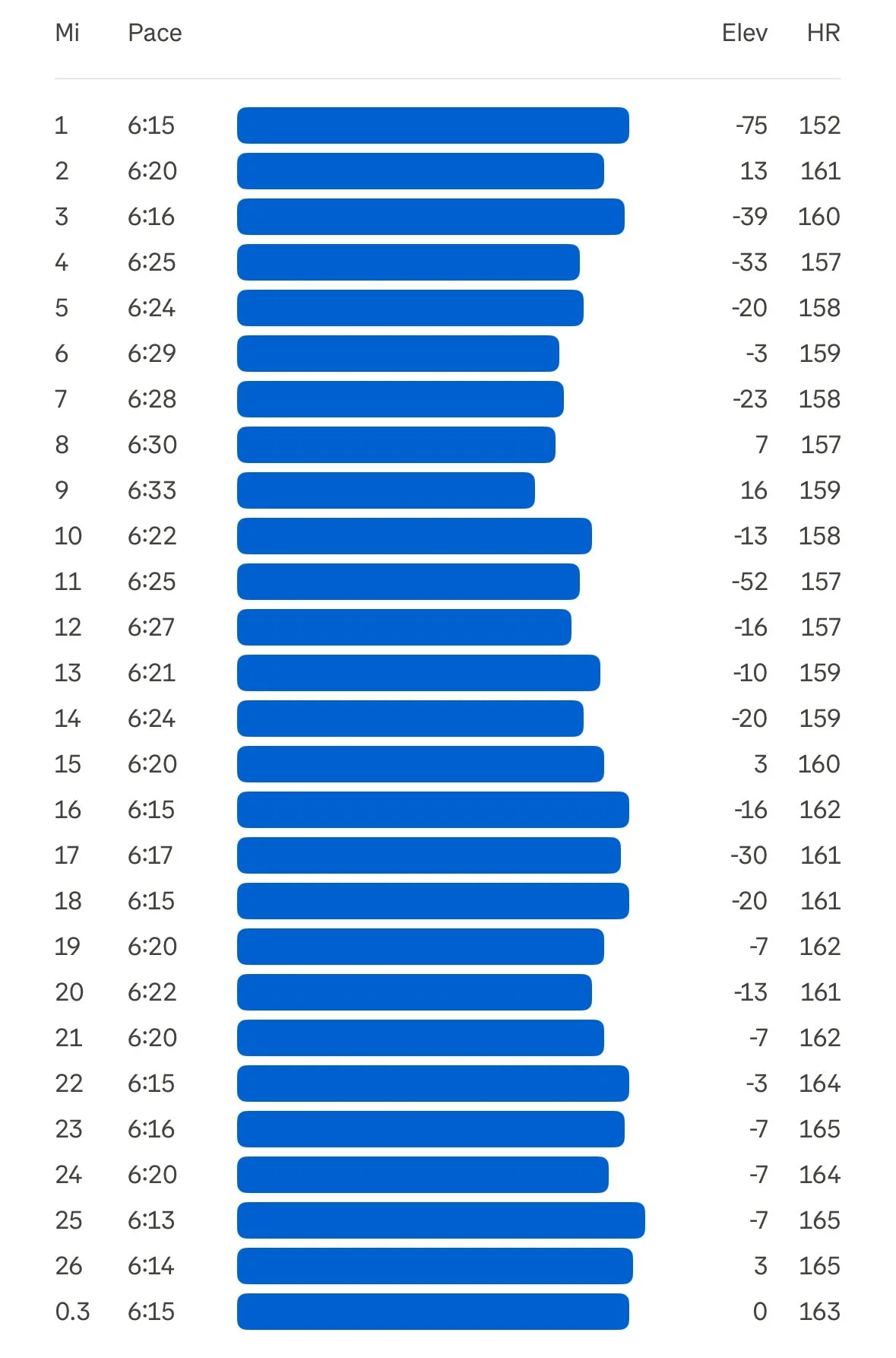
I have been able to do several lactate tests in labs, so I know my threshold levels well. While I will look at pace, I focus primarily on heart rate to ensure I’m hitting the right effort and not getting out over my skis. Here is the strategy:
Miles 0-10:
Keep the first 10 miles below the first lactate threshold
This means that I will be creating muscular fatigue but will not accumulate significant lactate
For me, this means keeping HR below 160
Miles 11-20
Increase HR to just above aerobic threshold
This is a low Z3 effort where I am now accumulating lactate, but hopefully not too much
For me this means 161-162 HR
Mile 21-26.2
Now is the time to push, and I increase HR to mid / high Z3
I’m building up lactate and walking a fine line of pushing hard but not breaking before the finish
For me this means 164-165 HR
You can see below that this played out perfectly for CIM. Miles 2 and 3 were a bit too hard at that early stage. Knowing my HR data so precisely let me realize that and ease off the gas, likely saving my race and enabling the strong second half.
Finally, if you are more of a trail and mountain runner, I strongly encourage you to switch things up and put in a road marathon training block. It can actually be a lot of fun and helps make you a better and strong runner.